Rugs look simple to sell online. They are flat, they ship rolled, and a good photo shows the pattern well. Yet rug shoppers hesitate for the same reasons, and ask the same questions, on almost every product page. If those questions are not answered on the page, shoppers leave to search, message the shop, or buy elsewhere.
This guide lists the questions rug shoppers ask most often and explains how to answer each one clearly on the product page.
Why rug shoppers have so many questions
A rug is a big visual element in a room, it is often expensive, and it is awkward to return. Shoppers need to be confident about three things: that it fits the room, that it looks right with what they already own, and that it will hold up to daily life. Most questions fall into one of those groups.
The best source for your own list is your inbox and your chat history. Read the last few months of customer questions and group them. You will likely find that most fall into the categories below.
"What size do I need?"
This is the most common rug question, and the one that causes the most returns.
How to answer it
- Give every size in both metric and imperial units, and say whether the size includes the fringe.
- Add simple sizing guidance for common rooms: in a living room, a rug large enough for at least the front legs of the sofa and chairs to sit on it; under a dining table, enough extra space for chairs to be pulled out without catching the edge; in a bedroom, extending beyond the sides of the bed.
- Show diagrams of each size in a typical room layout.
- Suggest a test: mark the rug size on the floor with masking tape or newspaper before ordering.
- Offer a visual check. A rug visualizer lets shoppers place the rug in a photo of their own room and switch between sizes, which is often the quickest way to see whether a size works.
"What does it feel like underfoot?"
Shoppers cannot touch the rug, so describe it carefully.
How to answer it
- State the pile height and type: low, medium or high pile; cut or loop; flat-woven.
- Describe the feel in words: soft and dense, firm and flat, textured and nubbly.
- Show close-ups of the surface with light from the side, and a side view of the edge showing thickness.
- Name the construction: hand-knotted, hand-tufted, flat-woven, machine-made, and what that means in practice for durability and feel.
- Offer swatches for higher-value rugs where possible.
"Is the colour accurate?"
Rug colours vary with light, and dyed natural fibres can vary between batches.
How to answer it
- Photograph rugs in daylight, with a consistent setup across the range.
- Include at least one room shot and one close-up for each colour.
- Describe the colours in words, including undertones.
- Note any natural variation clearly for handmade or natural-fibre rugs.
- If the rug has a pile direction, explain that it can look lighter or darker from different sides.
"Will it work with pets, children or a busy hallway?"
This is a question about durability and cleaning, and shoppers want honest answers.
How to answer it
- Name the material and its typical traits in general terms. Wool tends to be resilient and naturally resistant to soiling; some synthetics are easy to clean; natural fibres such as jute have a lovely texture but can mark with water.
- Say where it suits: living room, bedroom, hallway, kitchen, outdoors.
- Be honest about limits: high pile and loose weaves may not suit pets that scratch; light colours show marks in busy areas.
"How do I clean it?"
How to answer it
- Give clear care instructions on the page, not only on the label.
- Say whether it can be vacuumed, with or without a beater bar, and whether spot cleaning or professional cleaning is advised.
- Mention shedding if the rug is likely to shed at first, and that it usually reduces with time. Shoppers who are warned in advance rarely complain.
"Does it need an underlay?"
How to answer it
- Say whether you recommend an underlay for this rug and floor type, and why: to stop slipping, add comfort, or protect the floor.
- Offer the right underlay size as an add-on, sized to the rug.
- Mention compatibility with underfloor heating if relevant.
"Will it lie flat?"
Rolled rugs often arrive with curled edges. Tell shoppers this is normal, and give simple advice: lay it out and let it settle, or reverse-roll the corners. This one sentence prevents many anxious messages.
"When will it arrive, and what if it is not right?"
How to answer it
- Show delivery times clearly, especially for made-to-order sizes.
- State the returns policy plainly: the window, the condition required, who pays for return shipping, and any exceptions for custom sizes.
- Explain how a large rug is packaged and returned, so shoppers know it is manageable.
Bring the answers together on the page
A product page that answers all of this can become long. Structure helps:
- Above the fold: images, price, size selector, delivery estimate and the key traits (material, pile, construction).
- Just below: sizing guidance and the visualizer.
- Further down: details, care, underlay, and returns, in short sections or expandable panels.
- At the end: a short FAQ built from the questions you actually receive.
Answer the questions you have not predicted
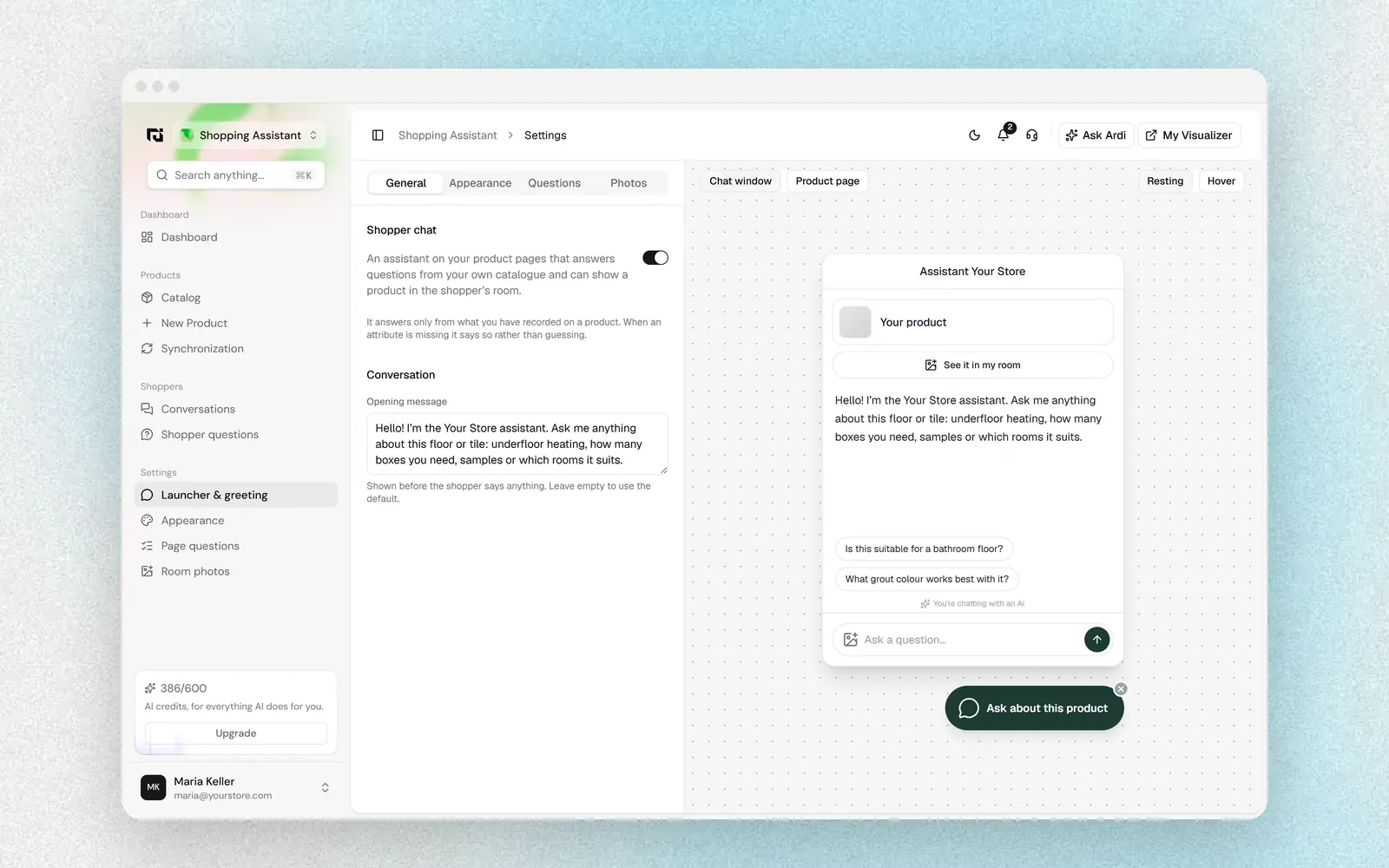
Even a well-structured page will not answer every question. An on-page assistant that answers from your own catalogue data can handle the long tail: "Is the 200 x 300 in stock?", "Does this come in a runner?", "Will this work with a grey sofa?". Ardealy's shopping assistant is built to answer this way, from your products, and hand over to your team when it does not know. Whatever you use, the answers must come from your data, not guesses.
Learn from the questions
Questions are useful feedback. Review them regularly:
- If many shoppers ask about size on one rug, the sizing guide on that page may be unclear.
- If they ask about colour, the photos may not show it well.
- If they ask about shedding or cleaning, add it higher on the page.
Each fix reduces questions and, often, returns.
Where Ardealy fits
Ardealy gives rug retailers a rug visualizer that lays the rug in the shopper's room at the size they choose, a shopping assistant that answers from your catalogue, and tools for content and follow-up, with your approval before anything goes out. The carpet and rugs page shows the setup.
FAQ
What is the most common reason rugs are returned?
Wrong size and colour expectations are frequent reasons. Clear sizing guidance, consistent photography and a way to see the rug in the shopper's room all help.
Should we offer rug swatches?
For higher-value rugs, swatches help shoppers judge colour and feel. Make them easy to order and say how big they are.
How long should a rug product page be?
As long as it needs to answer the main questions, but structured so the key information is at the top and details are easy to scan.
How do we describe pile height?
Give the height in millimetres or inches and describe it in words, such as low, medium or high pile, with a side-view photo of the edge.
Can an assistant answer stock and size questions?
Yes, if it reads from your live catalogue. It should pass questions it cannot answer to a person rather than guess.