Small home goods businesses are usually run by a few people doing many jobs. The same person who chooses the stock also answers customer emails, posts on social media, sets up ads and tries to keep the website current. Marketing is often the job that gets the least time, even though it brings in the next month's customers.
AI tools now promise to help, and some describe themselves as a whole marketing team. That can be useful, but only if you know what such a team can actually do well, where it falls short, and how to keep control. This article is an honest look at all three.
What we mean by an AI marketing team
An AI marketing team is a set of AI agents, each handling a type of marketing work, coordinated in one place. A typical set includes agents for:
- content: product photos, room scenes, short videos
- social media: planning, writing and scheduling posts
- email: newsletters and follow-up for leads and quote requests
- ads: building campaigns and suggesting budget changes
- analysis: sales, search presence, competitors and page health
- the shop itself: catalogue checks and on-page assistance for shoppers
The agents do the work. A person decides what goes out.
What it can do well
Produce first drafts quickly
AI is good at turning a brief into a reasonable first draft: a week of social posts, a newsletter, product descriptions, ad variations. For a small team, starting from a solid draft rather than a blank page saves real time. The drafts still need your eye and your voice, but editing is faster than writing.
Make content from what you already have
From one good product photo, AI tools can produce room scenes, different crops for different channels, and short videos. For a small business that cannot afford a shoot for every new product, this makes it possible to show products in context. The furniture photography guide covers how to do this without misrepresenting the product.
Keep routine work on schedule
Many marketing tasks are simple but easy to let slip: posting regularly, sending the monthly newsletter, following up sample requests, checking that product pages have descriptions and images. Agents can keep these on a schedule and prepare them for you to approve, rather than relying on you to remember.
Watch things you do not have time to watch
An agent can check your sales, ad results, search presence and competitor prices every day and tell you what changed. Most small business owners would like to do this and rarely have time. A short daily summary, with the few things that need attention, is often more valuable than any single piece of content.
Answer common shopper questions
An on-page assistant that answers from your catalogue can handle the questions shoppers ask repeatedly: dimensions, materials, care, stock and delivery. It works out of hours and passes anything it cannot answer to you.
Follow up leads consistently
Quote requests and sample orders are easy to lose track of. An agent can draft follow-up emails based on what the shopper asked for, at sensible intervals, and stop when the shopper replies.
What it cannot do
Know your customers the way you do
You know why your regulars come back, what they say in the shop, which products they love and which they return. AI can read your data, but it does not have the conversations, the relationships or the instinct you have built. Its suggestions are only as good as the information it can see.
Set your brand and taste
A small home goods business usually succeeds because of someone's taste: the selection, the styling, the voice. AI can follow a style once it is defined, but it cannot decide what your brand should stand for. Define it, give examples, and correct drafts that drift.
Guarantee results
No tool can promise that an ad will sell or a post will be seen. Anyone claiming guaranteed results from AI marketing should be treated with caution. What AI can do is make good practice cheaper and more consistent: more testing, steadier posting, faster follow-up.
Replace judgement on spending and risk
Deciding how much to spend on ads, whether to discount, or how to reply to an unhappy customer involves judgement about your finances and reputation. Agents can suggest and explain. You decide.
Fix problems outside marketing
If products arrive damaged, stock runs out, or delivery takes too long, no amount of marketing will fix it. In fact, an honest AI analysis will often point to these issues, because they show up in returns, reviews and questions.
Be right every time
AI makes mistakes. It can write something inaccurate about a product, generate an image that changes a detail, or misread a trend in the numbers. That is why review matters.
Why approvals matter
The most important design choice in an AI marketing setup is what it is allowed to do on its own. A sensible rule for a small business:
- Agents may prepare anything: drafts, images, campaign plans, reports.
- Nothing that spends money, publishes or changes the shop happens without your approval. That includes posts, emails, ad budgets and website changes.
In practice this means a queue of proposals: a week of posts to review, a budget change with a reason, a follow-up email ready to send. You approve, edit or reject each one. It takes a few minutes a day and keeps you in control of your brand and your money.
Over time you may choose to approve some routine things in batches, but the default should be that a person sees what goes out.
How to start without overwhelming yourself
- Pick one or two jobs that are currently not getting done, such as regular social posts or sample follow-up.
- Give the agents good inputs: clear product data, good photos, a short description of your brand voice, and examples of posts and emails you like.
- Review everything for the first few weeks, and correct drafts so the output improves.
- Add the daily summary of sales, ads and competitors once the basics work.
- Expand gradually to ads, content and on-page tools.
Questions to ask any AI marketing tool
- What can it do without my approval, and can I change that?
- Where does it get its information about my products, and how current is it?
- Can I see and edit everything before it goes out?
- How does it handle shopper data, and where is it stored?
- What does it cost as usage grows?
Where Ardealy fits
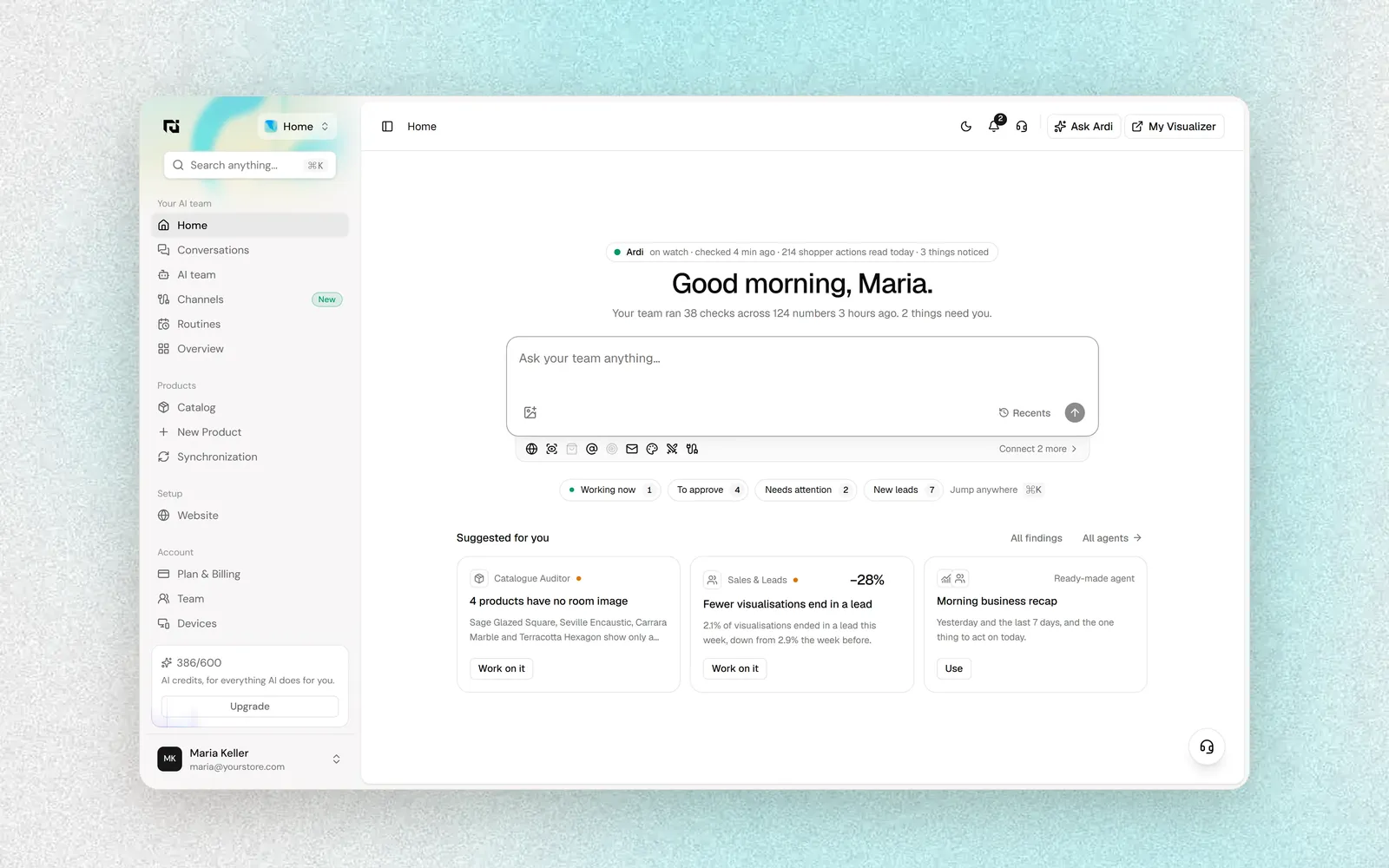
Ardealy is built as an AI marketing team for businesses that sell for the home: a lead agent, Ardi, coordinating specialist agents for content, social and email, ads, competitors, catalogue checks and analysis, alongside the visualizer and shopping assistant for your product pages. Nothing that spends money, publishes or changes the shop goes out without your approval. The pricing page shows the plans, which include everything and differ by AI credits, and you can book a demo to see it on your own shop.
FAQ
Can an AI marketing team replace a marketing hire?
For some small businesses, it can cover routine work that would otherwise not get done. It does not replace the judgement, taste and customer knowledge of the owner or a skilled marketer.
How much time does reviewing AI work take?
It depends on volume. With good inputs and a clear approval queue, many owners spend a few minutes a day, more at the start while the agents learn your style.
Will AI content sound generic?
It can, if it is given little guidance. Clear brand notes, good examples and editing early drafts make a large difference.
Is it safe to let AI run ads?
It is sensible to let AI propose campaigns and budget changes, and to keep approval of spend with a person.
What should we hand over first?
Work that is regular, repetitive and currently not getting done, such as social posting and lead follow-up, is usually the best place to start.