Flooring and tile shoppers compare. Many ranges are sold by several retailers, sometimes under the same name, and a shopper planning a whole floor can see a meaningful difference in total cost from a small difference per square metre. If you do not know where your prices sit, you are making pricing decisions blind.
Watching competitor prices does not mean matching every cut. Done well, it tells you where you are exposed, where you have room, and where the real competition is on service rather than price. This guide explains how to set it up and how to use what you learn.
Why price watching matters in flooring and tile
A few features of the trade make prices especially visible:
- Shared ranges. The same manufacturer's products are often sold by many retailers.
- Price per square metre. Shoppers can compare like for like quite easily.
- Large orders. A small difference per unit becomes a large difference on a full project.
- Price comparison and shopping ads. Search engines show several retailers' prices side by side.
At the same time, the cheapest price does not always win. Delivery, sample service, advice, stock, lead times and fitting all matter, and shoppers weigh them.
Decide what to watch
You do not need to track every competitor and every product. Start small and focused.
Choose the competitors
Pick a handful of competitors that your customers actually compare you with. Good sources:
- the shops that appear next to you in shopping ads and search results for your main products
- the names your sales team hear from customers
- local showrooms near your own, if you have one
Three to six competitors are usually enough to start.
Choose the products
Focus on:
- Products sold by both you and the competitor, the same range and the same size, where comparison is direct.
- Your best sellers, where a price gap affects the most revenue.
- Close equivalents for own-label or exclusive ranges: a similar oak engineered plank with the same width and wear layer, or a similar porcelain tile in the same size and finish.
Write down the matching rules for equivalents so the comparison stays consistent over time.
Compare like with like
Raw prices are misleading unless they are compared on the same basis. For each product, record:
- price per square metre (and per box or tile, if that is how it is shown)
- pack size and coverage, since boxes vary
- delivery cost for a typical order size, and any free delivery threshold
- sample cost and policy
- stock status and lead time
- promotions: percentage off, bundle offers, trade discounts shown publicly
- the date checked
A competitor with a lower price per square metre but a high delivery charge may cost the shopper more overall for a typical order. Calculating a total for a sample project, for example a given area plus delivery, makes the comparison realistic.
How to collect the data
Manual checks
For a small list, a monthly or fortnightly manual check in a spreadsheet works well. It is slow, but it builds real understanding of how competitors present their products.
Tools and automation
For larger catalogues, price monitoring tools can check competitor product pages regularly and record changes. If you use automated tools:
- respect competitors' terms and the law in your country, and do not overload their sites
- check that product matches are correct, especially for similar names and sizes
- keep a human review of significant changes before acting on them
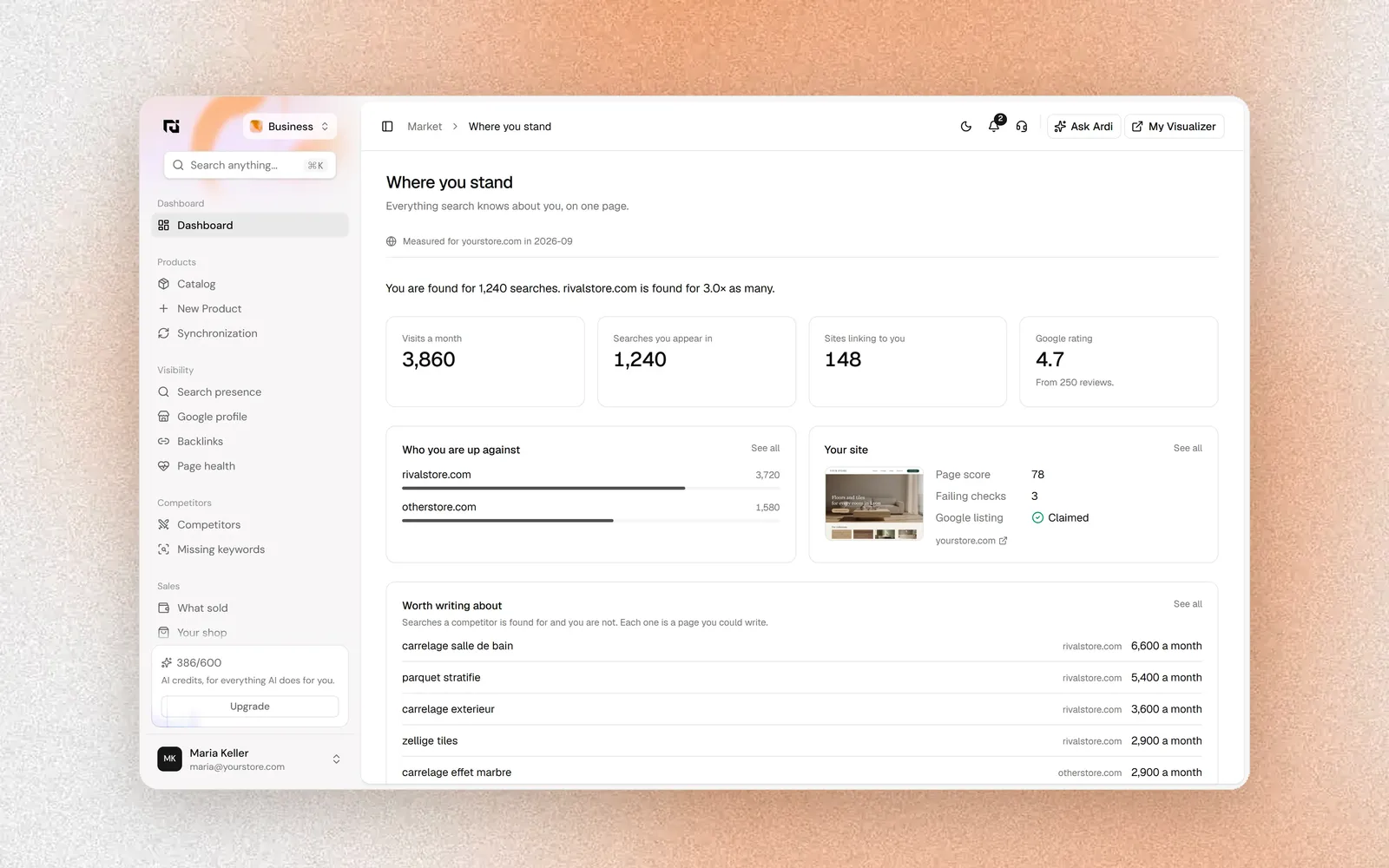
Ardealy's Competitor Watch agent, part of business analysis, is one example of this approach: it follows competitor prices and positioning and reports changes for you to review.
Read the results, not just the numbers
Look for patterns
Over a few months, patterns appear:
- Which competitors are consistently cheaper, and on which products?
- Which run regular promotions, and when?
- Where are you more expensive with no obvious reason?
- Where are you already the cheapest, perhaps without needing to be?
Separate price from value
When you are more expensive, ask whether shoppers are getting something for it. Faster delivery, free samples, larger samples, expert advice, a showroom, fitting, better product pages and photography: all of these justify a difference, but only if shoppers can see them. Make them visible on product pages.
Watch for stock and lead time signals
A competitor showing long lead times or out-of-stock items on a popular range is an opportunity. If you have stock, make it clear on your product pages and in your ads.
Decide how to respond
Price watching should lead to deliberate decisions, not automatic reactions. A simple decision framework:
- Hold when the gap is small and you offer clear extra value.
- Adjust when you are noticeably more expensive on a directly comparable best seller, with no clear advantage.
- Highlight when you are already competitive: show the total project cost and your service clearly.
- Promote selectively, on chosen products and for set periods, rather than reacting to every competitor promotion.
- Differentiate by moving attention to exclusive or own-label ranges where direct comparison is harder.
Always check margins before lowering prices. A race to the bottom on shared ranges benefits nobody, least of all smaller retailers.
Use what you learn in marketing
Competitor information is useful beyond pricing:
- Ads: spend more where you are competitive and in stock, and less where a competitor is clearly cheaper on the same product. Ardealy's Ads agent proposes changes of this kind for you to approve.
- Product pages: make total cost, delivery and service visible on the products where shoppers compare most.
- Content: if competitors are winning on certain searches, consider guides and pages that answer those searches better.
Common mistakes
- Comparing prices without delivery and pack sizes.
- Matching competitor prices on products that are not truly the same.
- Reacting daily to small changes.
- Tracking too many competitors and products to act on.
- Forgetting that the shopper sees the whole offer, not only the price.
Where Ardealy fits
Ardealy's business analysis watches competitor prices and positioning, maps where you stand, and shows missing keywords and page issues, all summarised for you daily. Changes to ads or pages are proposals you approve. The flooring page and pricing page explain what is included.
FAQ
How often should we check competitor prices?
For most flooring and tile retailers, a monthly or fortnightly check is enough for a focused list, with automated tools for larger catalogues.
How many competitors should we watch?
Start with three to six that your customers actually compare you with.
Should we always match the lowest price?
No. Check whether you offer extra value, such as delivery, samples, advice or stock, and make that visible. Adjust prices deliberately on direct comparisons where it makes sense.
How do we compare own-label products?
Define close equivalents by specifications such as size, thickness, wear layer, finish and material, and keep the matching rules consistent.
Is automated price monitoring allowed?
Rules differ by country and by site. Check the terms of the sites you monitor and the law where you operate, and avoid overloading other sites.